

- English
-
English
Current location:Home > Product > Pharmaceutical API
|
Manufacturing Process |
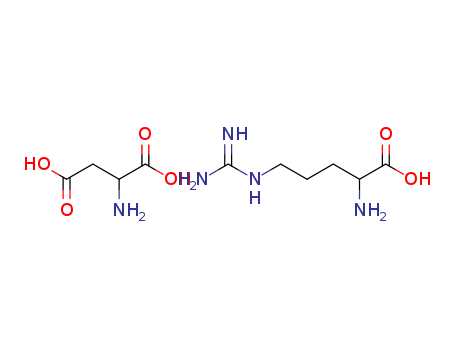
1000 ml of polystyrene-trimethylbenzylammonium ion exchange resin were converted into the chloride form by passing aqueous hydrochloride acid over the resin. The resin was washed with distilled water to remove all traces of passed over the resin. A 10% excess of the calcium aspartate solution over the theoretical ion-exchange capacity of the resin was used and the resin was then washed with water until the wash water was free of chloride ions. At the end of this treatment, the resin was in the aspartic acid form. An aqueous solution containing 168.56 g of calcium aspartate and 49.44 g of arginine dihydrochloride per litre was prepared, and this solution was passed slowly over the aspartic acid form resin. The effluent liquid was collected in fractions of 200 ml, then of 100 ml, and towards the end, in fractions of 50 ml. After about 1000 ml of eluate had been collected, the succeeding fractions were examined very carefully for the presence of chloride ion. All the eluate fractions prior to the first one containing traces of chloride, i.e. all the chloride-free eluate fractions, were combined, the combined chloride eluates amounted to about 1300 ml. The arginine present was determined by Sakaguchis method and the total nitrogen in the combined eluates was also determined. These determinations showed that the eluates contained from 270 to 300 g of arginine aspartare per litre. The combined eluates were evaporated to a volume of about 500 ml and allowed to crystallize at a low temperature (0°-4°C). After seeding with a crystal of arginine aspartate, colourless crystals were obtained, they were filtered off, washed with aqueous ethanol, and then dried. About 210 g, i.e. 70% of the theoretical yield, of crystals having a decomposition point of 220°C was obtained. The mother liquor from the first crystallization was evaporated down to a volume of about 150 ml. Ethanol was added to the solution until cloudiness which persisted was obtained, the solution was cooled to 0°C and a second crop of crystals was obtained. The size of this second crop was increased by adding further ethanol after the major portion of the second crop had crystallized and allowing the mixture to stand for 48 hours at 0°C. After separation, the second fraction consisted of 75 g of a crystalline mass which had the same physico-chemical and chemical properties as the main fraction. |
|
Therapeutic Function |
Tonic, Stimulant, Hepatoprotectant |
InChI:InChI=1/C6H14N4O2.C4H7NO4/c7-4(5(11)12)2-1-3-10-6(8)9;5-2(4(8)9)1-3(6)7/h4H,1-3,7H2,(H,11,12)(H4,8,9,10);2H,1,5H2,(H,6,7)(H,8,9)/t4-;2-/m00/s1
The effervescent tablet contains an effe...

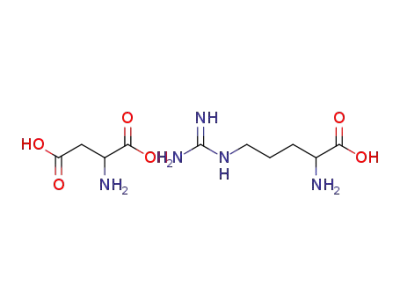
L-aspartic acid, compound with L-arginine (1:1)
| Conditions | Yield |
|---|---|
|
|
|
|
Benzyliden-arginin, Aspartic-Saeure;
|